174010
/ 8
Min Read
174010
/ 8
Min Read


Launching a business is frequently likened to taking a risk. Many aspiring business owners are cautious due to the unpredictability, investment concerns, market competition, and operational difficulties. However, what if there were a method to become a business owner with less risk, more support, and a better chance of success? Enter the Franchise-Owned, Company-Operated (FOCO) model. This powerful hybrid business model combines the strength of franchising and the operational management of company-run stores. This blog will discuss why investors and entrepreneurs view it as a low-risk or risk-free opportunity.
Why the FOCO Model?
Before investing money in a business, franchisees and new entrepreneurs always scout for a well-planned business format or model that promises good returns on investment. While doing so, one question that strikes the franchisee’s mind is – which business plan or model can guarantee a risk-free business opportunity?
Besides relying solely on the Company Owned Company Operated (COCO) model for expansion, franchisors nowadays are offering Franchisee Owned Company Operated (FOCO) and Franchisee Owned Franchisee Operated (FOFO) models to start their entrepreneurial journey either by investing in the brand or independently running the brand’s operations at one’s own risk. Looking at the pros and cons of all three business models (COCO, FOCO, and FOFO), some franchise brands are now thinking of including these business models in their franchise agreement to double their footprint across the country. Also, the franchisee can choose between the business models by doing a thorough market research about the feasible yet profitable business model as per their investment capability and experience in running the business.
The FOCO model, which stands for Franchise-Owned, Company-Operated, is quickly becoming popular due to its clever balance of professional management and ownership. Here is a summary of the main factors that set the FOCO model apart from traditional business or franchise models, in case you were wondering why you should pick it:
Low-Risk, High-Potential Investment
Within the FOCO model:
Although you own the store, the brand manages it on your behalf.
The corporation takes over the operational risk, which is typically the biggest concern in business.
You don't have to bother about day-to-day operations and get assured or consistent returns.
Why it matters: Inexperience or poor operations account for the majority of small business failures. FOCO eliminates that obstacle.
.jpg)
No Operational Pain
Forget about:
- Employing or terminating employees
- Problems with inventory
- Managing suppliers
- Consumer grievances
- Marketing initiatives
Everything is managed by the franchisor. You play the part of a financial owner, such as an investor or landlord. If you want business returns without full-time work, this is perfect.
Promised or Certain Returns
Numerous FOCO franchises provide:
- Monthly revenue that is fixed
- or a profit share plus a minimum guaranteed return
This provides you with income security, making it similar to passive investments like real estate, but with a higher return on investment (often 15–30% per year).
No Need for Experience
With FOCO, you don't need:
- Business expertise
- Experience in the industry
- HR or retail expertise
This is the ideal chance for:
- Professionals in the workforce
- Senior Citizens
- NRIs
- New business owners
Without a significant skill curve, anyone with money can start their own business.
Which Business Model is Preferred?
In franchising business, franchisors keep hopping on new business models that have the potential to generate profits for the brand and its franchisees. One of the leading tour and travel operators, Thomas Cook is one such brand that has witnessed the outcomes of both these models. Over the subject of these models, which is more feasible and profitable, Jatinder Paul Singh, Sr. V.P. & Head - Sales & Distribution Leisure Travel (Outbound), Thomas Cook (India) Ltd says, “For our brand, FOCO model emerges as the more feasible and profitable venture because on one hand, the franchisee gets its proceeds sharing without participating in the business operations and on the other hand, the enterprise gets verve to its brand by prolonging quality. Otherwise, out of the COCO and FOCO models, choosing the more practicable model would completely depend on the individual’s preference on taking up the commerce as an investor or as an entrepreneur.”
Amit Chawla, Head Business & Franchise Development, Strands Salons Pvt. Ltd says, “In COCO model, responsibility of the investment, expansion and optimum utilisation of resources is on the company while, FOCO is a good example of value for money. In addition, FOCO offers minimal risk for both franchisor and franchisee. Franchisor has lot to do in FOCO model as they can get the things done as per their norms taking the franchisee along.”
Experts feel that FOCO model is considered a cut above than other franchise models. Speaking about the reasons for choosing FOCO over FOFO model, Amit Chawla says, “After one year or so, franchisees try to get hold of the things without adhering to the company’s policies in the specified manner, leading to drop in the brand value. In the wake of that, Return on Investment (RoI) that is usually committed to three years goes to five years. On the other hand, FOCO is a partnership model and company has the liability to give RoI on time either it’s in loss or profit. Our outlets running on FOFO model is now planning to switch over to FOCO looking at its promising returns.”
Singh says, “FOCO offers better value for both the franchisee and consumer with better buying power, consolidation etc. Moreover, franchisee can focus their energies on the promotion and sales, leaving the operation and logistics to the brand company. On one hand, aspiring entrepreneurs having large amount of capital in the pocket to invest are likely to take it FOFO model as the store runs independently merely by adhering to the brand’s guidelines. Whereas, FOCO model permits the enterprise to run store's operations without franchisee's intrusion and gets revenue share self-reliantly.”
FOCO Model Turns Out To Be Safest For Franchisees
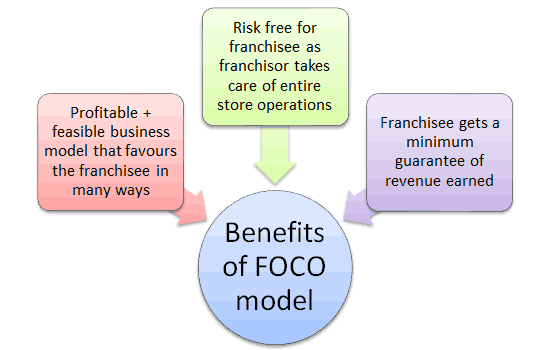
FOCO module has the franchisee investing fixed cost while, running cost is borne by company and in return, franchisee gets a minimum guarantee or percentage of revenue earned. It also shields franchisee from bearing Capital Expenditure (Capex), which is a type of outlay made by the companies to renovate or upgrade physical assets like property, industrial buildings and equipment, increasing the scope of their operations. On the flip side, some opines that the capex is borne by the franchisee and rest of the outlays by the company. To know about the kind of liabilities and expenses, franchisee is supposed to make in FOCO model, Jatinder Paul Singh says, “The basic expenses are the rent, salaries and the running costs; but the franchisees have the freedom to invest and spend on short-term and long-term promotional and marketing activities, and on purely case-to-case basis, Thomas Cook also supports the franchisee with promotional/ BTL (Below The Line) activities to inspire demand. Also, to encourage franchisees to invest in building the brand presence and developing the market, Thomas Cook also offers an attractive special marketing support bonus as part of the Productivity Linked Bonus (PLB) pay-out annually. Liabilities for the franchisee are minimal, since there is no special proprietary equipment or pre-purchased inventory being held by the franchisee.
Amit Chawla says, “In FOCO, franchisee has to make one time investment in the total project cost. In return, we waive the franchisee off from other type of fees and charges especially franchisee fee. We become partner with franchisees. Thereon, the outlays on monthly basis are borne out of the sales. During the testing times, we keep around 25:75 contributory ratio of franchisor and franchisee respectively."
In a nutshell, experts strongly feel that FOCO model can turn out to be right pick for the first time entrepreneurs and franchisees as it guarantees minimal risk as franchisee just invests in the brand and rest the company takes care of brand’s overall operations.
FRANCHISE FACTS.gif)
The FOCO (Franchise-Owned, Company-Operated) model is a safer and more intelligent option in an environment where traditional entrepreneurship frequently requires a high level of risk, time, and experience. It provides the operational power of expert management along with the financial advantages of business ownership. Due diligence is crucial, just like with any investment. Selecting a reputable brand with a tested FOCO structure, however, is more than just launching a company; it means securing a long-term, risk-reduced opportunity.